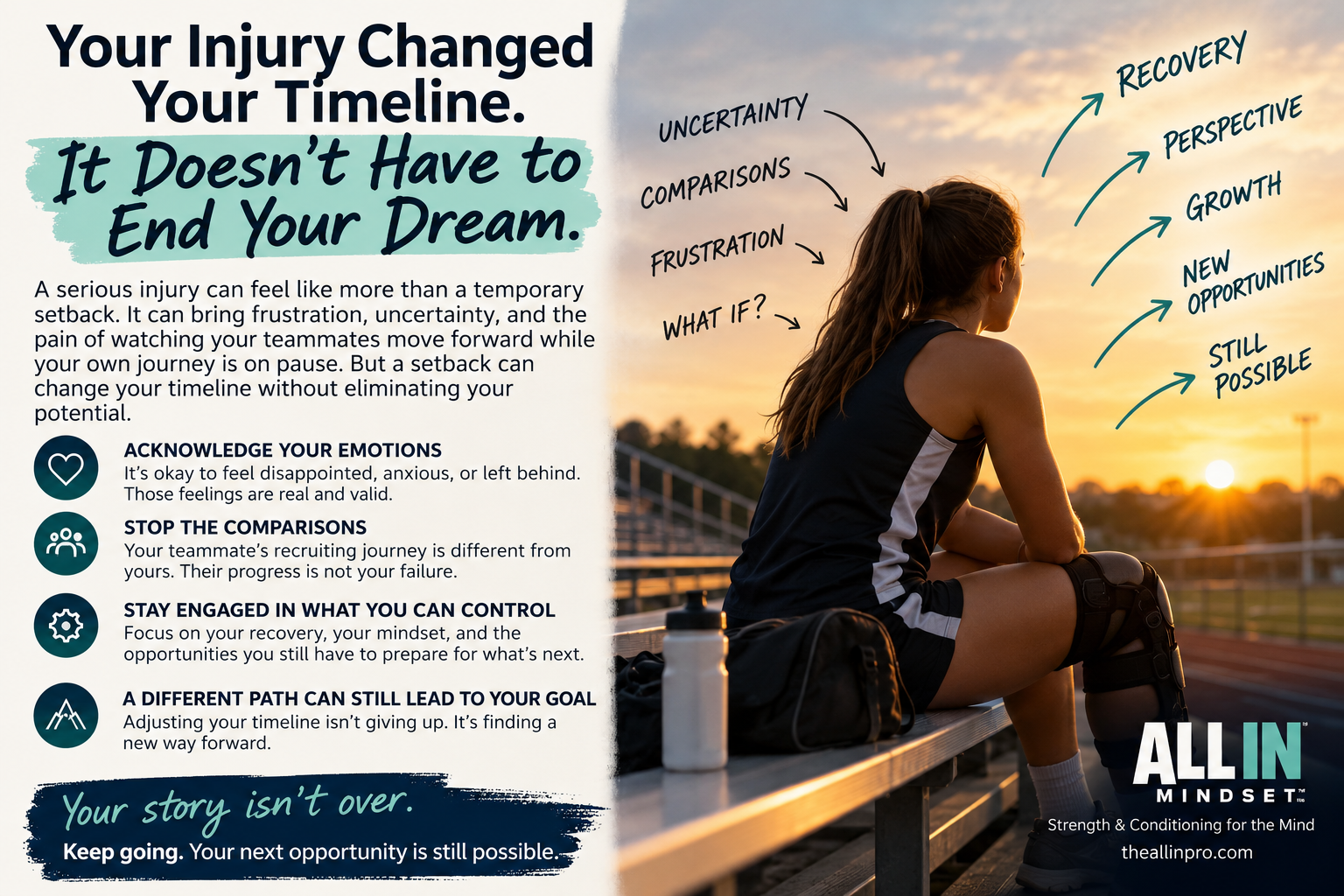
Your Injury Changed Your Timeline. It Doesn't Have to End Your Dream.
By Dr. Heather D. Larkin, LMHC, MGCP, MPM, AIMC | ALL IN Counseling & Mental Performance Coaching, LLC
An injury can affect far more than a season. For a teenager watching teammates commit, it can feel like the future is being decided without them.
There was a time when everything seemed to be falling into place. You were starting. You were competing. You were developing your skills, building your stats, collecting game film, and working toward the opportunity to play your sport at the collegiate level. You had a plan. And then came the injury. Suddenly, instead of competing alongside your teammates, you're watching from the sideline. Your days are filled with medical appointments, rehabilitation exercises, physical limitations, and uncertainty about when, or whether, you'll return to the athlete you were before.
The starting position you worked so hard to earn now belongs to someone else. Your teammates are receiving recruiting interest, taking official visits, posting commitment announcements, and celebrating opportunities you've spent years preparing for. Every new commitment seems to remind you of what you've lost. And somewhere along the way, the questions begin. "What if I'm never as good as I was?" "What if the coaches who were interested in me have moved on?"
"What if I've fallen too far behind?" "What if my dream of playing in college is over?" For an injured high school athlete, these questions can become overwhelming. Because the hardest part of a significant injury isn't always the physical pain or rehabilitation. Sometimes, it's watching the future you imagined continue without you.
But here's something I want every injured athlete to understand: A setback can change your timeline without eliminating your potential.
Your path may need to look different than you originally planned. Different does not automatically mean worse. And adjusting your goals is not the same as giving up on them.
You're Not Just Recovering from an Injury. You're Adjusting to a Loss.
When athletes experience a serious injury, the attention understandably focuses on physical recovery. How is the healing progressing? When can rehabilitation begin? When will they be cleared to return? Will they regain their strength, speed, mobility, and confidence?
But there's another part of recovery that deserves just as much attention. The emotional impact. For many athletes, their sport is a significant part of their identity. It influences their friendships, daily routines, personal goals, and vision of their future. An injury can temporarily disrupt all of those things. You may feel disconnected from your teammates, anxious about your future, angry about what happened, or jealous of athletes who are continuing to compete.
You may even feel guilty for experiencing those emotions. After all, your teammates are your friends. You want them to succeed. But watching them achieve the very opportunities you were working toward can hurt. You can genuinely be happy for someone else and still be disappointed about your own circumstances. Those emotions can coexist. The important thing is learning how to acknowledge what you're experiencing without allowing those feelings to determine what happens next.
You do not need to pretend you're fine. You do need to recognize when your disappointment is beginning to influence your motivation, confidence, behavior, and willingness to continue pursuing your goals.
Stop Comparing Your Recovery to Someone Else's Recruiting Journey
Comparison can become one of the most damaging mental habits during injury recovery. Before your injury, you may have compared statistics, performance, playing time, and recruiting interest. Now you're comparing timelines. Who's committed? Who received another offer? Who's being recruited at a higher division? Who's getting the exposure you're missing?
Social media can make those comparisons nearly impossible to escape. And when you're already questioning your future, every recruiting announcement can feel like evidence that you're falling further behind. But you're comparing two very different circumstances. Your teammate's recruiting journey is continuing under one set of conditions. Yours has been interrupted by something largely outside your control. Their progress is not proof of your failure. Their opportunity does not eliminate yours.
The question isn't whether you're keeping pace with everyone else. It's whether you're making meaningful progress within the circumstances you're currently facing. That shift in perspective matters. Because when athletes become consumed with the opportunities they're missing, they often overlook the opportunities they still have to prepare for what's ahead.
The ALL IN Mindset™: Five Pillars for Navigating Injury, Uncertainty, and Your Next Opportunity
Recovery requires more than physical rehabilitation. It requires the ability to manage emotions, adjust expectations, remain engaged in the process, and rebuild confidence while navigating uncertainty.
The ALL IN Mindset™ provides five essential pillars for doing exactly that.
1. Awareness: Separate What Happened from What You're Telling Yourself It Means
One of the most important skills an injured athlete can develop is recognizing the difference between facts and the conclusions they're drawing from those facts.
Consider the difference:
Fact: You suffered an injury and cannot currently compete. Conclusion: "My athletic career is over."
Fact: You lost your starting position while recovering. Conclusion: "I'll never earn it back."
Fact: Several teammates have committed to colleges. Conclusion: "No college will ever want me."
The facts may be disappointing. But the conclusions are predictions, not certainties.
When athletes repeatedly treat their fears as facts, they can begin to lose confidence in a future that hasn't actually been determined.
Awareness means recognizing those thought patterns and challenging them with more balanced, realistic thinking. Instead of saying, "I'll never play in college now," consider:
"My recruiting situation has changed. I need to understand my recovery timeline, evaluate my current options, and develop a realistic plan."
That doesn't guarantee a particular outcome. It puts you in a better position to influence what happens next. Your injury is part of your athletic story. It does not have to become the conclusion of it.
2. Let Go of Limitations: Release the Belief That There's Only One Path to Success
Many high school athletes develop a very specific picture of what collegiate success should look like. Graduate high school. Sign with a Division I or Division II program. Move onto campus. Earn playing time. Build a successful college career. And if that picture changes, they begin to believe they've failed. But who decided there's only one acceptable route to collegiate athletics?
The truth is that athletes develop at different rates, encounter different obstacles, and follow different paths. Some are recruited early. Others develop later. Some need additional physical preparation. Others need more competitive experience, academic development, or time to recover from injury. For an injured athlete, the original recruiting timeline may no longer align with their physical readiness or competitive opportunities. That doesn't necessarily mean the original goal is impossible.
It may mean the route requires adjustment. A postgraduate year, junior college, a smaller collegiate program, or a different competitive level may provide an opportunity to rebuild. The critical question becomes: "What environment will give me the best opportunity to recover fully, develop my abilities, continue my education, and realistically pursue the next level?"
Let go of the belief that one school, one division, one scholarship, or one recruiting timeline determines your worth. Your goal is to find the right opportunity, not simply the most impressive announcement.
3. Lock In on W.I.N.: What's Important Now?
Injured athletes often become so focused on the future that they struggle to commit to the present. Will I be ready for next season? Will I get recruited? What if I lose my scholarship opportunity? What if everyone else passes me?
Those are understandable concerns. But worrying about a future recruiting decision will not improve today's rehabilitation session.
The ALL IN Mindset™ teaches athletes to redirect their attention toward W.I.N.—What's Important Now?
During recovery, W.I.N. may look very different than it did when you were healthy and competing. It may mean completing your prescribed rehabilitation exercises with proper technique. It may mean following medical restrictions rather than rushing your return. It may mean maintaining academic performance, reviewing game film, improving tactical knowledge, or staying connected with your team. On some days, what's important now may simply be allowing your body the recovery time it needs.
That isn't weakness. That's discipline. Recovery is not a race to prove how badly you want to return. It's a process of preparing your body and mind to return safely and effectively. A medically appropriate recovery plan must guide your physical progression.
Your responsibility is to execute what is appropriate for your current stage rather than becoming consumed with what you aren't yet able to do.
4. Intrinsic Confidence: Rebuild Your Belief Before You Rebuild Your Statistics
Injury can challenge an athlete's confidence in ways they may never have experienced before. Before the injury, confidence may have come from starting, competing, making plays, receiving recognition, and seeing measurable improvements. Now those sources of validation may be temporarily unavailable. You can't produce game statistics when you aren't playing. You can't demonstrate your explosiveness while you're still recovering. And you can't measure your value by recruiting attention when college coaches haven't had an opportunity to evaluate your return.
This is where intrinsic confidence becomes especially important. Your confidence must be grounded in more than what your body can currently do or what others are saying about your potential. Remember the athlete you were before the injury. Not simply the statistics or achievements, but the qualities that helped you get there. Your discipline. Your work ethic. Your competitive mindset. Your ability to learn. Your commitment to improvement.
Those qualities didn't disappear when you got injured. You may need to rebuild your physical abilities and your trust in your body. But you are not starting from nothing.
Create a confidence resume that includes your previous accomplishments, positive feedback, strengths, examples of adversity you've overcome, and evidence of progress throughout rehabilitation. Continue adding to it. Sometimes the most meaningful improvement isn't visible on a scoreboard.
It's recognizing that you've regained mobility, reached a rehabilitation milestone, developed greater patience, or successfully completed an activity that previously created anxiety. Confidence is rebuilt through evidence, preparation, and experience: not through forcing yourself to believe that everything will work out exactly as planned.
5. Next Play Mentality: Adjust the Plan Without Abandoning the Goal
In sports, athletes learn that they cannot change the previous play. They can review it, learn from it, and make adjustments. But eventually, they must redirect their attention toward what happens next. Injury recovery requires that same mentality. You cannot change the injury. You cannot recover the games you missed. You cannot control when your teammates receive offers. And you cannot guarantee that your recruiting process will resume exactly where it left off.
What you can do is evaluate your circumstances and determine your next productive action. That is the foundation of a Next Play Mentality.
Use the ALL IN Reset Routine:
Verbal Cue: "ALL IN!"
Physical Cue: Take a controlled breath, release unnecessary tension, and reset your posture.
Next Play Intention: Identify the specific action that moves you forward. Some days, your Next Play is rehabilitation. Other days, it's updating your recruiting profile, contacting a coach, researching programs, meeting with your academic counselor, or adjusting your goals.
You don't have to have your entire future figured out today. But you do need to remain engaged in building it. Changing the plan isn't quitting. Refusing to consider another path because it isn't the one you originally imagined may be what keeps you stuck.
When Plan A Changes: Understanding Your Collegiate Options
One of the most important conversations I have with athletes is about the difference between lowering expectations and adjusting expectations. Lowering expectations suggests that you're giving up on your potential. Adjusting expectations means evaluating where you are today and identifying the less rigid and absolute, and most realistic steps toward where you want to go. There are several pathways injured athletes may consider.
Option 1: A Postgraduate or Bridge Year
For some athletes, an additional year between high school graduation and full-time college enrollment may provide time to complete rehabilitation, regain competitive readiness, strengthen academics, and develop updated performance film. A legitimate postgraduate program may offer academic coursework, structured training, competitive opportunities, and guidance through the recruiting process. However, not every program offers the same resources or recruiting exposure. A bridge year also does not guarantee additional eligibility, college admission, or a future scholarship.
Athletes must evaluate the program's academic quality, coaching, costs, medical and rehabilitation support, and recruiting outcomes. Most importantly, they need to understand how delaying enrollment and participating in organized competition may affect their eligibility under the rules applicable to their sport and intended college division.
Option 2: Junior College (JUCO)
Junior college can be a valuable option for athletes who need additional competitive experience, academic preparation, physical development, or an opportunity to rebuild their recruiting profile. For an athlete recovering from injury, a well-matched junior college program may provide an opportunity to return to competition, generate new film, and pursue future four-year college opportunities. But JUCO should be treated as a deliberate educational and athletic decision, not an automatic stepping stone to Division I.
The level of competition, quality of coaching, strength and conditioning resources, academic support, affordability, and transfer opportunities vary significantly. Athletes should also understand how entering a two-year college affects their eligibility timeline and future transfer requirements.
Option 3: Competing at a Different Collegiate Level
Sometimes the most productive opportunity isn't at the division an athlete originally envisioned. A Division II, Division III, NAIA, or other appropriate collegiate program may offer a stronger overall fit. The right environment may provide more realistic opportunities for development, an academically suitable program, and a coaching staff that values the athlete's potential. And for athletes who eventually hope to transfer, future opportunities may develop through demonstrated performance and continued improvement, subject to transfer and eligibility rules.
But choosing a lower division should never be viewed as a guarantee of a future transfer to a higher one. Playing at the right level and continuing to grow is more meaningful than committing to a prestigious program where the fit isn't right.
Option 4: Reassess the Goal Without Giving Up on Yourself
There are circumstances where a significant injury, ongoing medical limitations, academic considerations, or personal priorities may make collegiate competition unrealistic or no longer desirable. Athletes deserve honest conversations about those possibilities. Not every injury can be overcome through determination alone. And not every athletic dream will unfold exactly as planned. If medical professionals determine that returning to competition is unsafe, protecting your long-term health must take priority.
But even then, your experience, discipline, knowledge, and love for your sport still have value. Coaching, sports medicine, performance analysis, athletic administration, and many other opportunities allow athletes to remain connected to sports.
The end of one competitive pathway does not mean the end of your purpose, potential, or identity.
Trust the Process, but Be Willing to Redesign It
Athletes hear "trust the process" constantly. But trusting the process does not mean waiting for something to happen. It means taking ownership of the actions that move you toward a meaningful, realistic goal. And sometimes, it means recognizing that your original plan is no longer the most effective route. You might need more time. You might need a different training environment. You might need to adjust the level of competition you're targeting.
You might need to rebuild your recruiting network and demonstrate your abilities through new performance film. Those adjustments do not diminish what you've already accomplished. They reflect an understanding that effective goal-setting must account for current circumstances.
Be committed to your development, but flexible about the route. The strongest athletes are not always those who follow their original plans without interruption. Sometimes they're the ones who have the courage to acknowledge that the plan has changed, make informed adjustments, and continue moving forward.
The ALL IN Recovery and Recruiting Reset: Build a New Game Plan
If your injury has disrupted your college recruiting journey, don't make decisions about your future based solely on fear, disappointment, or comparison. Take the time to develop a plan grounded in accurate information, realistic expectations, and meaningful action.
Step 1: Understand Your Recovery, Not Just Your Return Date
Work with your medical and rehabilitation team to understand your current limitations, recovery milestones, and criteria for safely returning to competition. Being medically cleared is an important milestone, but rebuilding sport-specific conditioning, confidence, and performance may take additional time. Don't rush your return because your teammates are getting recruited.
Your long-term health is more important than keeping pace with someone else's timeline.
Step 2: Reevaluate Your Recruiting Profile
Take an objective look at where you are today. What competitive film do you have from before your injury? What were your performance strengths? Which programs previously expressed interest? What level of competition realistically aligns with your abilities, academic profile, and projected recovery?
Seek feedback from people who understand your sport and collegiate recruiting standards. Be willing to hear information that challenges your original expectations.
Accurate feedback may be uncomfortable, but it's necessary for making informed decisions.
Step 3: Develop Three Potential Pathways
Instead of placing all your hopes on one outcome, create three possible plans.
- Plan A: Your preferred pathway. The collegiate level and schools you originally hoped to attend, if they remain realistic.
- Plan B: Your adjusted pathway. A different division, smaller program, or competitive environment that aligns more closely with your current readiness.
- Plan C: Your developmental pathway. A carefully evaluated postgraduate year, junior college, or alternative option that allows more time to recover, compete, and reassess your future.
Each plan should include academic requirements, costs, potential recruiting opportunities, and an honest assessment of your readiness.
Having multiple options isn't a lack of confidence. It's preparation.
Step 4: Communicate With College Coaches
Don't automatically assume that previously interested coaches have lost interest. When appropriate, communicate professionally about your injury, recovery progress, anticipated return, and continued interest in their program. Be truthful about what you can and cannot currently do. Provide relevant updates and available film, and ask whether there may still be a potential fit. Coaches may have moved in another direction. Some opportunities may no longer be available.
That's disappointing, but accurate information is better than allowing assumptions to dictate your future.
Step 5: Rebuild Through Measurable Goals
Set goals that reflect your current phase of recovery. Focus on medical and rehabilitation milestones, academics, mental performance, recruiting communication, and preparation for future competition. Review those goals regularly with the people supporting your recovery. Some will need to be adjusted. That's expected. Progress isn't always linear, and a slower recovery period isn't evidence that you're failing.
Success during recovery should be measured by what you're appropriately working toward; not simply by how quickly you return to where you were.
A Message to Parents: Help Them See Possibilities Without Making Promises
Parents, watching your child experience the loss of a season, a starting position, or a potential recruiting opportunity can be heartbreaking. You've witnessed their sacrifices. You know what this dream means to them. Your natural instinct may be to reassure them that everything will work out. But telling an injured athlete, "Don't worry, you'll still get that scholarship," may unintentionally create more pressure when the outcome remains uncertain.
They need hope, but they also need honesty. Listen to their disappointment without immediately trying to solve it. Allow them to grieve the opportunities they've lost while helping them recognize the choices they still have. Support the exploration of alternative pathways without presenting them as failures or second-best outcomes. And be mindful of your own expectations. Your child's future deserves to be bigger than the college logo on their sweatshirt.
Their physical health, emotional well-being, education, relationships, and long-term development must remain central to the conversation. The greatest support you can provide isn't a guarantee that their original dream will happen. It's the confidence that you'll support them as they make thoughtful decisions about whatever comes next.
A Message to Coaches: Don't Let an Injury Make an Athlete Invisible
Coaches, injured athletes may no longer be contributing on the field or court, but they're still part of your team. And for athletes who have spent years working toward collegiate opportunities, the fear of being forgotten can be just as difficult as the physical recovery. Continue including them in team activities where medically appropriate. Recognize their leadership, knowledge, preparation, and contributions. Communicate about their development and potential return without making promises you cannot guarantee.
When possible, help them connect with appropriate recruiting resources and provide honest evaluations of their collegiate potential. If a different competitive level or pathway appears more realistic, have that conversation with care and clarity. An injured athlete needs more than a rehabilitation plan. They need to know their value to the team hasn't disappeared because their ability to compete has temporarily changed.
Your influence during this period can have a lasting impact on how that athlete views adversity, confidence, and personal worth.
Final Thought: You Are Not Behind. You're on a Different Path.
I want to leave every injured athlete with something important to consider. Right now, you may feel like everyone else is moving forward while you're standing still. Your teammates are committing to schools. Your former starting position has been filled. Your recruiting timeline looks nothing like the one you imagined. And the future you worked so hard to create suddenly feels uncertain. But an interrupted timeline is not the same as a failed future.
You may need another year to develop. You may begin at a smaller program than you originally envisioned. You may need to rebuild your confidence, your strength, your skills, and your recruiting opportunities. And yes, you may eventually discover that your future looks different from the one you once planned. None of those possibilities makes you less of an athlete or less deserving of success.
What matters now is how you respond to the circumstances in front of you. Don't let disappointment convince you to quit before you've explored your realistic options. Don't allow comparison to turn someone else's success into evidence that yours is impossible. And don't become so attached to one version of your future that you overlook other opportunities worth pursuing. You can hold on to your dream while changing the plan.
You can maintain high standards while adjusting your expectations. You can be disappointed about what you've lost while remaining determined to discover what's still possible. And you can recognize that the strongest decision isn't always to push harder. Sometimes, it's to recover, reassess, redirect, and rebuild. Your injury may have taken away a season. It may have changed your recruiting journey. It may have forced you to reconsider the pathway you once believed was certain.
But it has not taken away your ability to make meaningful decisions about your future. Don't confuse a change in direction with the end of the road. Stay ALL IN on your development. Stay ALL IN on your recovery. Stay ALL IN on creating a future worth pursuing—even if the path looks different than you originally imagined. That's the ALL IN Mindset™.
Join the Conversation
For athletes: Which of the five pillars feels hardest to practice right now, and what is one Next Play you can take today?
For parents: How can you offer hope and honesty at the same time while your athlete rebuilds their path?
For coaches: What is one way you can keep an injured athlete connected and valued this week?
Join the ALL IN Mindset™ Conversation
"What emotional intelligence skill do you find most challenging to demonstrate consistently under pressure?"
We invite you to share your perspectives and experiences. Reach out through our contact page to continue the conversation.
About the Author
Dr. Heather D. Larkin, LMHC, MGCP, MPM, AIMC is the Founder and CEO of ALL IN Counseling & Mental Performance Coaching, LLC. A former college athlete, experienced educational leader, licensed mental health counselor, and mental performance clinician, Dr. Larkin helps student-athletes navigate adversity, build intrinsic confidence, strengthen emotional regulation, and develop the cognitive skills necessary to perform under pressure. Through the five pillars of the ALL IN Mindset™, she works with athletes at every level to move beyond limitations, maintain perspective, and execute with confidence through the challenges of athletic and personal development.
Strength & Conditioning for the Mind.
Learn more at www.theallinpro.com.
References
Ardern, C. L., Taylor, N. F., Feller, J. A., & Webster, K. E. (2013). A systematic review of the psychological factors associated with returning to sport following injury. British Journal of Sports Medicine, 47(17), 1120–1126. https://doi.org/10.1136/bjsports-2012-091203
Ivarsson, A., Tranaeus, U., Johnson, U., & Stenling, A. (2017). Negative psychological responses of injury and rehabilitation adherence effects on return to play in competitive athletes: A systematic review and meta-analysis. Open Access Journal of Sports Medicine, 8, 27–32. https://doi.org/10.2147/OAJSM.S112688
Explore More from The ALL IN Mindset™
- The Importance of Mental Performance Training for Athletes: A Guide for Sports Parents
- The Power of Meta-Thinking: Understanding Our Triggers and Transforming Our Minds
- The ALL IN MINDSET Advantage: More Than Just a Growth Mindset
- Learn about The ALL IN Mindset™ framework.
- Explore our counseling and mental performance coaching services.
- Meet Dr. Heather Larkin.
- Contact us to start a conversation.
Ready to Get Started?
Get the Weekly Mental Performance Tip
One actionable mindset strategy each week — no spam, just value. Unsubscribe anytime.